StakeCheck

Don't pay for a dead claim.

Five-star seller feedback won't tell you the claim is void. Neither will the listing photos or the map pin. Sellers don't have to mention unpaid fees, overlapping claims, or land closed to mining, and once you've paid, it's your problem. $149 gets a person on our team digging through the BLM and county records before the seller gets a cent.

Usually in your inbox within 48 hours. Can't find your claim? Full refund.

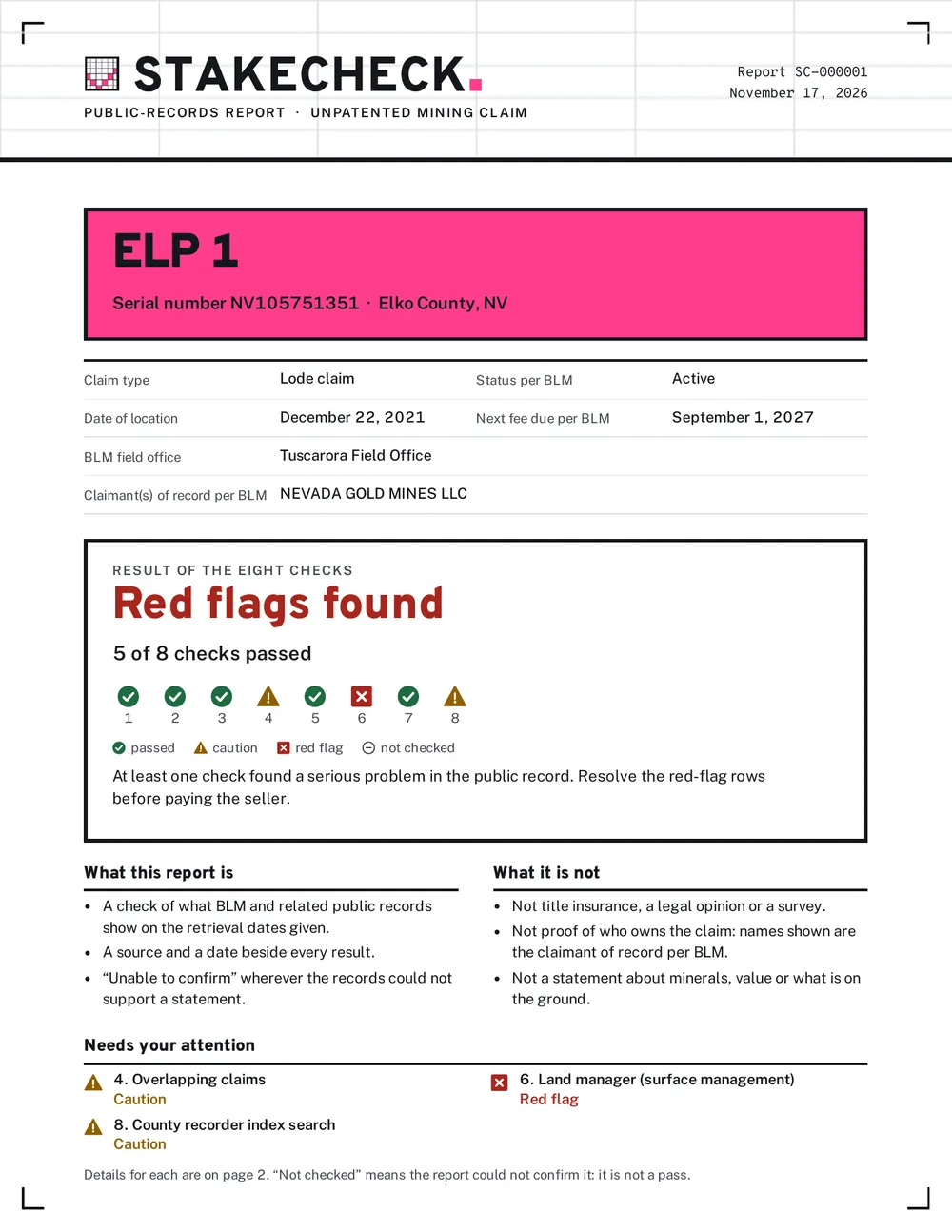
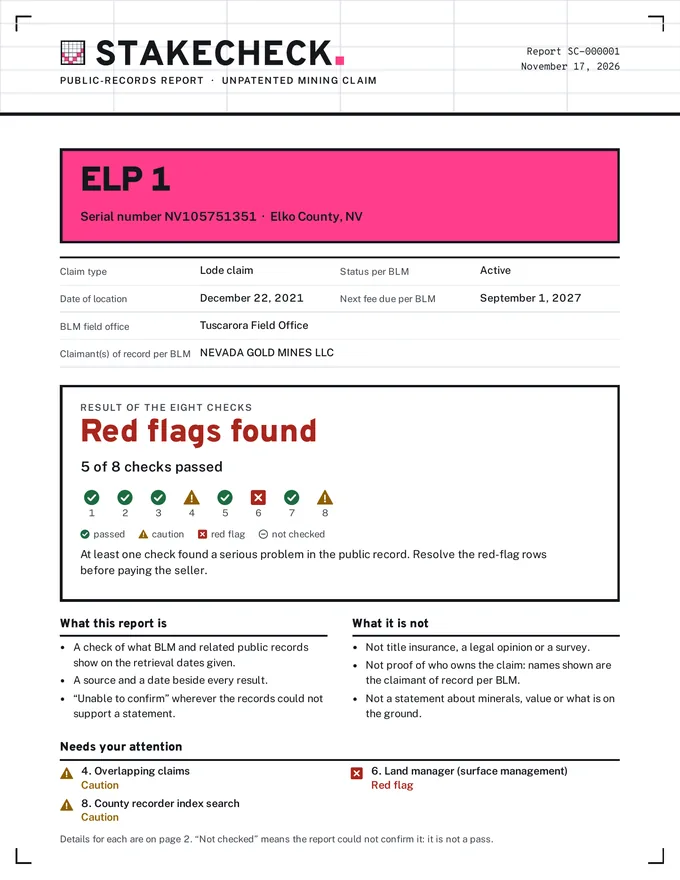
Page one of a real StakeCheck report for claim ELP 1, serial NV105751351. The result reads Red flags found, 5 of 8 checks passed, with eight marks for the individual checks.

Why check a mining claim before you buy? A seller's listing shows the good parts

Buyers in the forums say it every way they can: “dont put ANY money down until, you check things out” (V07). “Just because all the paperwork in order does not mean its valid” (V02). The listing is the seller's story, and the problems that cost buyers money are not in it.

Once the money has moved, nobody steps in. BLM's own brochure says “Money exchanged between private parties is a civil matter.” (BLM, “Buying A Mining Claim”, 2017)

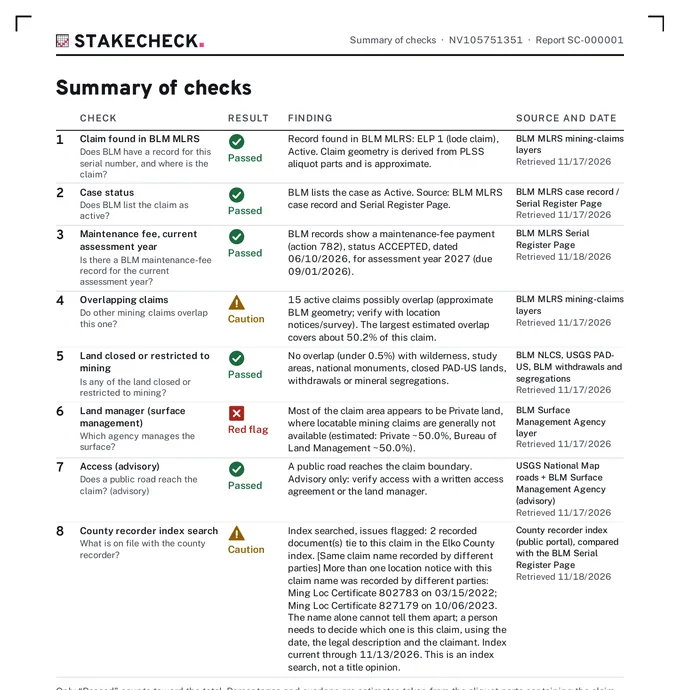
  • The claim is closed, or the fee was missed. “If you miss the date your claim is considered abandoned.” (V13)
  • Another claim sits on the same ground. “Two claims on one piece of land is a big red flag especially if one is for sale and the other not.” (V01)
  • The ground is withdrawn, private or landlocked. “They are also selling claims on withdrawn land and lands with no access because it is surrounded by private land.” (V01)
  • The seller is not the last name on the record. The county shows a deed that BLM does not.
  • A dead claim is being resold. “Some sellers will over claim another valid claim then turn around and sell to an unknowing person that may not have any recourse.” (V08)

How to research a mining claim: the answer is in there, but finding it takes know-how

You can look a claim up yourself, and plenty of experienced buyers do. Doing it well means:

  • finding the claim on BLM's MLRS (or the older LR2000) and the right Serial Register Page, which can be slow or fail to load;
  • reading the case actions and dispositions to tell an active claim from a closed or forfeited one;
  • checking which fee year is actually on the record, and whether a payment or a waiver shows;
  • plotting the neighbors to spot overfiles, and checking wilderness, withdrawals and who manages the surface;
  • going to the county recorder and matching its documents to the claim. County indexes list claims as ranges, such as “RAK 358 THRU 368”, and names collide, so a match takes judgment;
  • comparing the county's chain of documents against what BLM lists.

As one poster put it: “You must know how to find the listed claim on the LR2000 page or you cannot verify if the claim is still OPEN.” (V01) And: “Because the research is really the hardest part..” (V02)

StakeCheck does that work, county records included, and gives you the result.

Three steps, nothing charged until you confirm the claim

  1. Tell us the claim.

    A BLM serial number is best. A claim name with state and county, a pin on a map, or a listing link also works.

  2. Confirm the match.

    We show you the BLM record we found. You check it is your claim, then you pay $149.

  3. Get your verdict.

    A PDF by email: a clear result, the red flags, and what to do next. Usually within 48 hours. Some counties take up to 3 business days because their records take longer to search.

If we can't find your claim, you get a full refund.

More than a BLM mining claim search: a verdict you can act on

The cover tells you where you stand. One of three results: Clear, Caution or Red flags found, with how many of the eight checks passed. Red flags are listed in plain English, each with its source and the date it was retrieved.

Also included: the map page, the claimants of record per BLM, the case history, and a “what to do next” page.

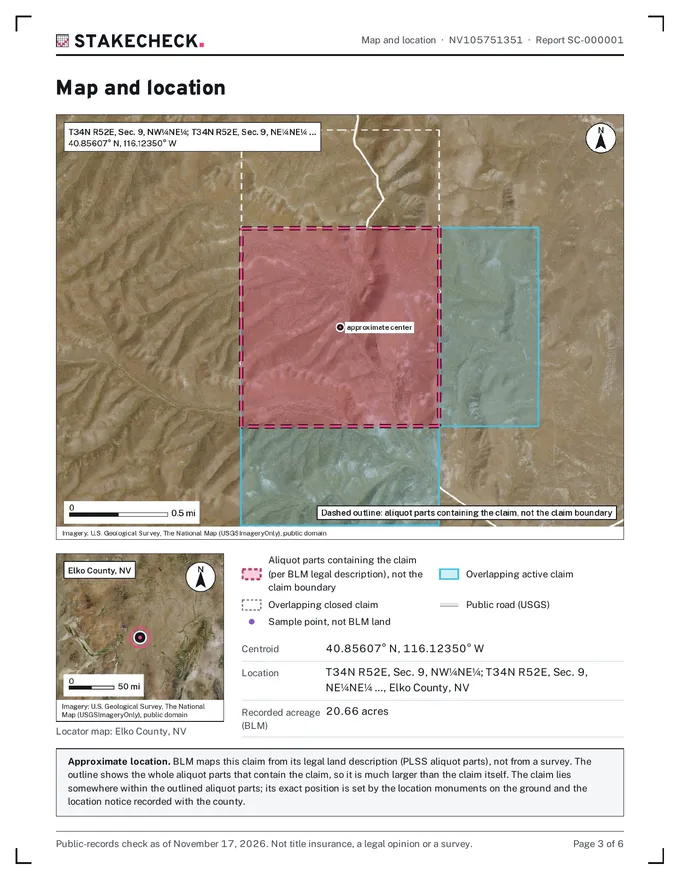
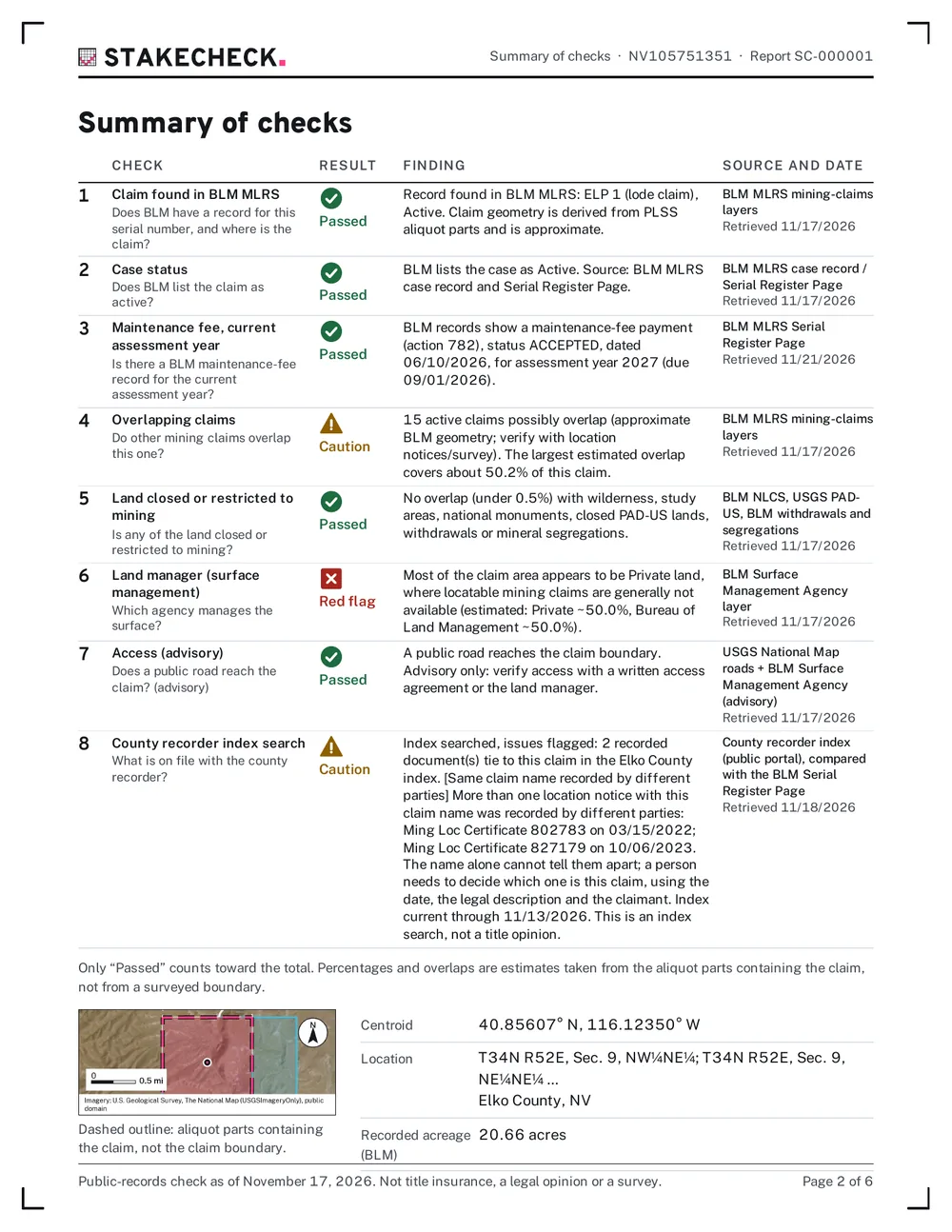
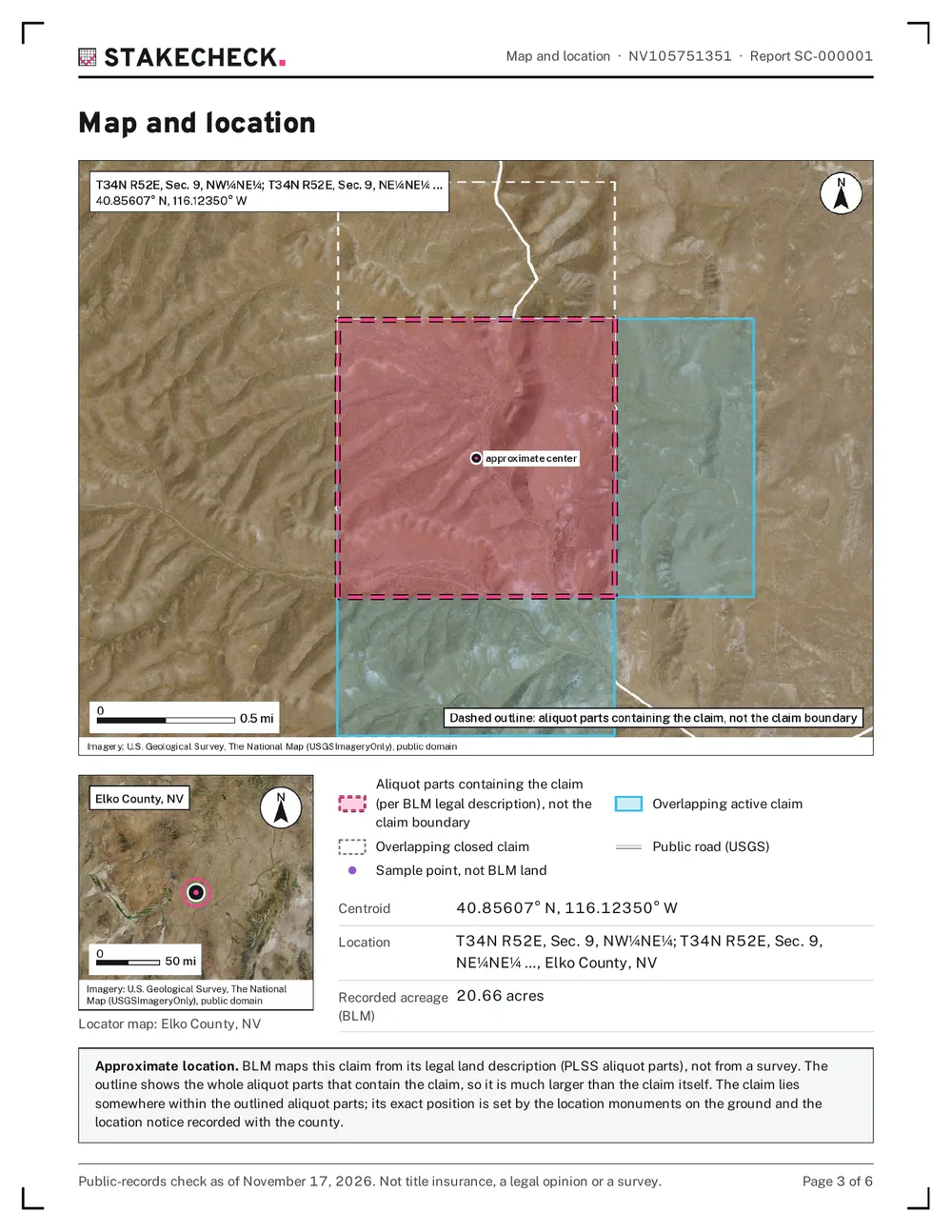
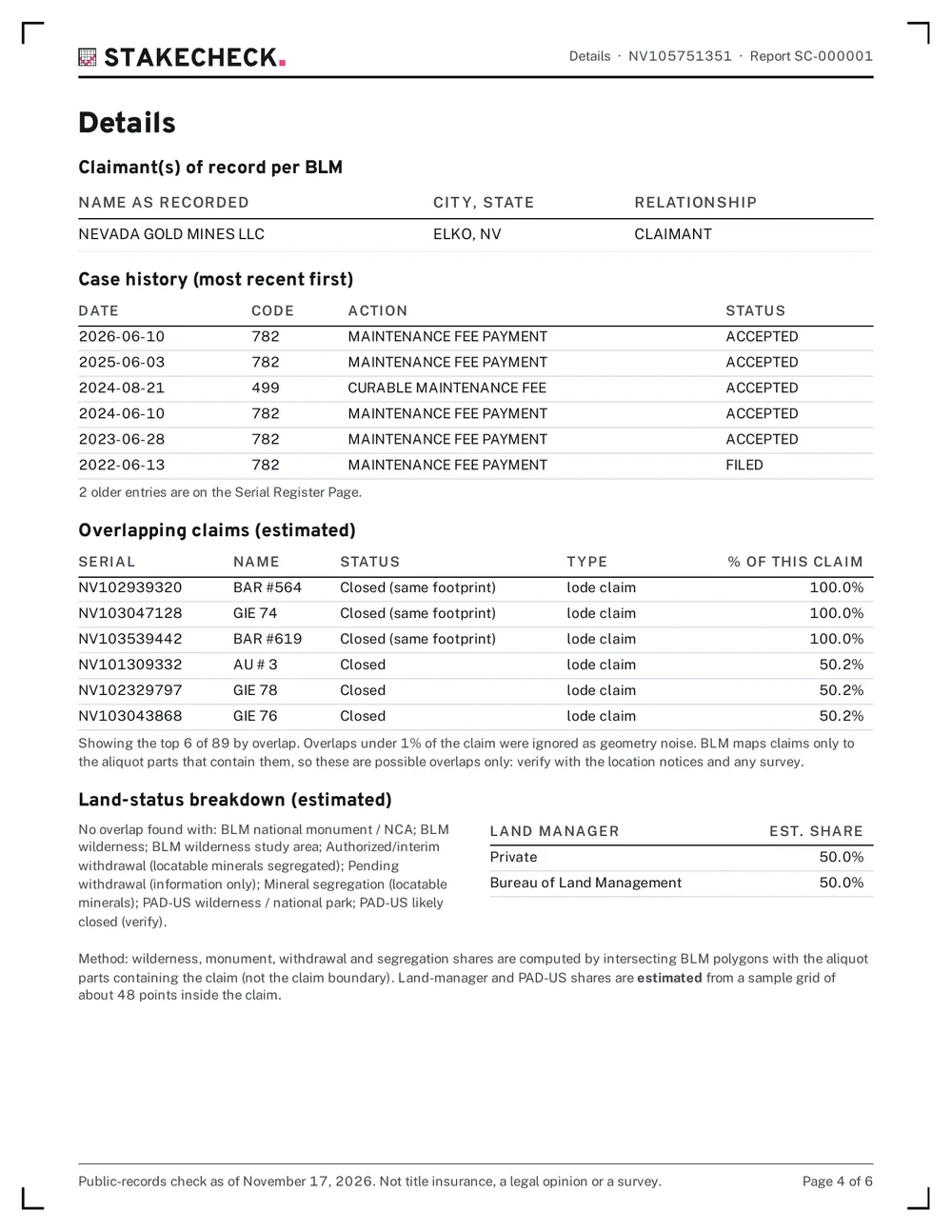
The summary-of-checks page of a real report, listing eight checks with a Passed, Caution, Red flag or Not checked mark, a finding, and a source with retrieval date for each. The map page of a real report: satellite view with the claim’s aliquot-parts outline, overlapping active claims in blue, and a locator map of Elko County, Nevada.

Eight checks behind it

  1. Does BLM have a record of the claim?

    Name, type and approximate location, from MLRS.

  2. Is it active or closed?

    Read from the case record and Serial Register Page, including the case actions that show a forfeiture.

  3. Is the maintenance fee on record for the current year?

    Fees are due each September 1. The report shows the payment or waiver on the record. If the record cannot show one, it says “Unable to confirm”.

  4. Does another claim sit on the same ground?

    Active claims that possibly overlap, with an estimated share. Outlines come from legal descriptions, so they are approximate and the report says so.

  5. Is the land closed to mining?

    Wilderness, study areas, monuments, withdrawals and segregations, with the share affected.

  6. Who manages the surface?

    BLM, Forest Service, state, private or another agency, with an estimated share.

  7. Does a public road reach it?

    Advisory only. Road data cannot prove legal access, so the report tells you to get access confirmed in writing.

  8. What do the county records show?

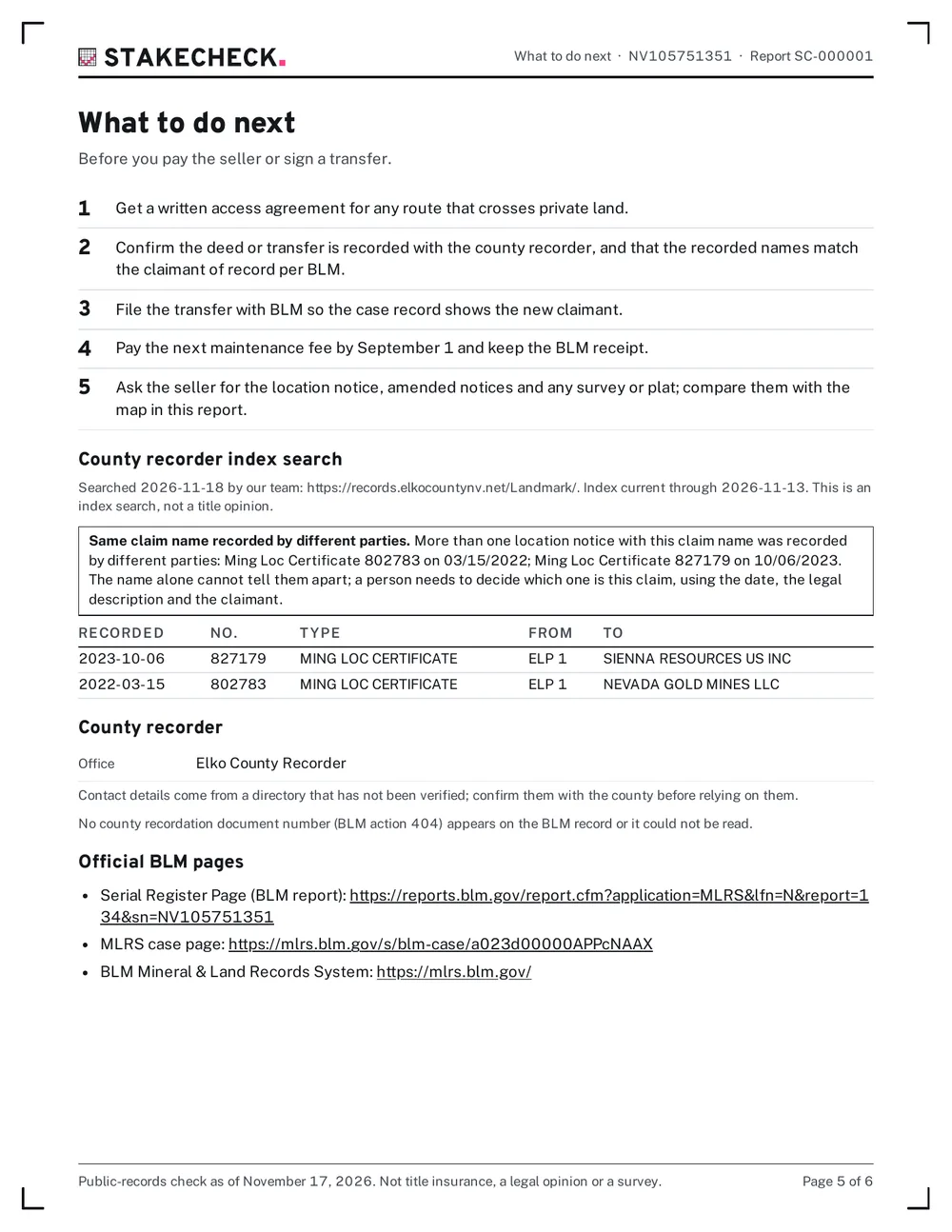
    Every order includes a search of the county recorder's index for the claim. The report says what was found, with links or references to the evidence. It can find transfers BLM does not list (see the Kern example).

Honest limits. Names appear as “claimant of record per BLM”, never as proof of who owns the claim. The county check is a search of an index, not a title opinion, and county indexes can lag or leave out claim names; where the index cannot support an answer, the report says “Unable to confirm”. The report says nothing about gold, mineral value or what is on the ground.

BLM still showed the old claimant. The county showed a transfer.

RAK #358 (CA101332839), Kern County, CA.

A deed to someone else, and BLM does not show it.

While building StakeCheck, we searched the Kern County recorder index for this claim and found Deed-Quitclaim 222121158, recorded August 4, 2022, from Glamis Rand Mining Co to New Verde Mines LLC. BLM still lists Glamis Rand as the claimant of record. A buyer reading only BLM would see the old name and never learn that a deed to someone else exists. A buyer who found the deed would still have to recognize the claim inside a listing that says “RAK 358 THRU 368”.

That is the kind of finding the county check in every order is built to catch. It is flagged as a possible transfer BLM does not show, for a buyer to raise with the seller and a lawyer before paying.

Two more real claims, run through the BLM checks (BLM data published November 17, 2026):

  • ELK 4 (NV101744695), Elko County, NV.

    Red flags found, 4 of 8 checks passed.

    BLM lists it as closed. The case history includes “CLAIM ABANDONED/FORFEITED”, accepted November 17, 2023, and no current-year fee payment is on the record.

  • ELP 1 (NV105751351), Elko County, NV.

    Red flags found, 5 of 8 checks passed.

    The claim is active and a 2026 fee payment shows. The report still flags that about half of the approximate outline appears to be private land (estimated), and that 15 active claims possibly overlap it.

These are public claims we checked ourselves. They are not customer orders. The BLM checks ran on November 17, 2026. For the county row we used a real search of the Elko County recorder's index made on November 18, 2026 (index current through November 13, 2026). For both claims the index lists more than one location notice under the same claim name, so the county row reads “Caution”. In a real order a person confirms which notice is the claim before the report is sent. The sample report shows the ELP 1 result.

See what the eight checks look like

$149, once, for one claim

You get a verdict, the red flags behind it, and a source and date for every finding. Usually within 48 hours. Some counties take up to 3 business days because their records take longer to search.

StakeCheck is a first screen: it tells you whether to keep going before you spend on deeper work, or send the seller a deposit.

What a mistake costs. Paying a seller for a claim that is closed, overlapped or on closed land means paying for something you cannot use. The report costs $149 before that decision, not after.

  • One PDF for one claim, with a search of the county recorder's index included.
  • A clear verdict, red flags in plain English, and the eight checks.
  • You see the BLM record we matched and confirm it before you pay.
  • If a claim cannot be matched, you can still order. A person then tries to identify it from the details you entered.

Check my claim, $149

If we can't find your claim, you get a full refund.

Other refund terms

Ask for a refund any time before delivery by replying to your order confirmation email. If we miss the delivery deadline that applies to your order (48 hours, or 3 business days where county records take longer to search), we send the checks we have confirmed, mark the rest “Not checked”, and offer a full refund. Once a report is delivered, it is delivered.

Questions about checking a mining claim

I can look up a mining claim on BLM's MLRS myself. Why pay?

You can, and some buyers do. The records are public. What you pay for is the work and the judgment: finding the right case and register page, reading the case actions and fee years, checking neighbors, land status and the county index, and telling you which findings matter. If you would rather do it yourself, every result in the report shows its source so you can see where to look.

Do you check county records for a mining claim?

Yes, in every order. We search the county recorder's index for your claim and report what we found, with links or references to the evidence. A search like this found the Kern deed above. It is an index search, not a title opinion.

How long does it take?

Usually within 48 hours. Some counties take up to 3 business days because their records take longer to search.

When do I pay?

You confirm we found the right claim before you pay. If we can't find your claim, you get a full refund.

Can I trust BLM's mining claim records?

They can lag. Fee payments and waivers sometimes take a while to show, and claim outlines come from legal descriptions, not surveys. That is why every result carries a retrieval date, and why the report says “Unable to confirm” when the record cannot support an answer.

Does the report tell me if there is gold?

No. It checks the claim's status and surroundings. It says nothing about minerals, value or what is on the ground. Sampling is a separate step.

What if you can't find my claim?

If we can't find your claim, you get a full refund. You can continue without a match; a person then reviews the order and tries to identify the claim from what you entered.

What if you're late?

If we miss the deadline that applies to your order, we send what is confirmed, mark the rest “Not checked”, and offer a full refund. You can also wait for the complete report.

Can I get a refund?

Yes, on request any time before delivery. Reply to your order confirmation email or write to hi@stakecheckreport.com.

What do I need to order?

A BLM serial number is best. Otherwise, the claim name with state and county, a pin on a map, or a listing link, plus your email address, which is where the report goes.

Which states do you cover?

Any US state where unpatented mining claims are recorded with the BLM, which is mostly the western states and Alaska.

Is $149 worth it on a small claim?

It depends on what you are about to spend. The report is built for purchases where a mistake would cost you more than a weekend.

Who is behind StakeCheck?

StakeCheck is operated by BORSALLEA GROUP LLC, a Wyoming LLC, at 30 N Gould St, Ste N, Sheridan, WY 82801. For questions, email hi@stakecheckreport.com.

What does a closed mining claim mean, and how do I avoid a mining claim scam?

The report tells an active claim from a closed or forfeited one by reading the case record and Serial Register Page, including the case actions that show a forfeiture. A closed claim like ELK 4 above reads “Red flags found”, with the source and the date it was retrieved. A claim can close because a fee date was missed: “If you miss the date your claim is considered abandoned.” (V13) The listing is the seller's story, and the problems that cost buyers money are not in it, so check the claim before you pay the seller. Once the money has moved, nobody steps in. BLM's own brochure says “Money exchanged between private parties is a civil matter.” (BLM, “Buying A Mining Claim”, 2017)

What does it mean to buy a mining claim? Do I own the land?

The report does not state who owns a claim. Names appear as “claimant of record per BLM”, never as proof of who owns the claim. What it does show is who manages the surface (BLM, Forest Service, state, private or another agency, with an estimated share), whether the land is closed to mining, and whether a public road reaches it. Road data is advisory only and cannot prove legal access, so the report tells you to get access confirmed in writing.

What is this report, legally?

The report is a summary of public records as of the dates shown. It is not title insurance, legal advice or a survey, and it does not state who owns a claim. Names appear as “claimant of record per BLM”. Use it to decide whether to go further, and have a lawyer or licensed surveyor confirm anything you rely on.

Check the claim before you pay the seller.

One claim, one verdict, $149. If we can't find your claim, you get a full refund.

Check my claim, $149

A summary of public records, not title insurance, legal advice or a survey.